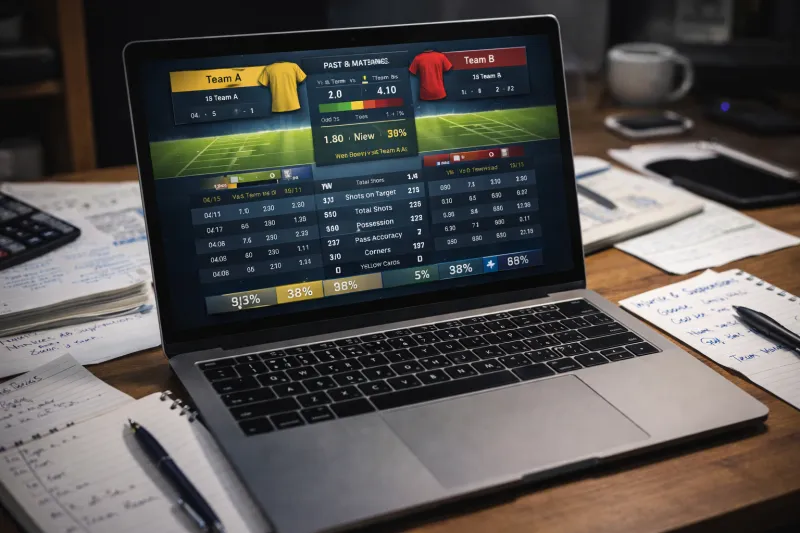
The 222-Minute Rule: Why Spending Just Over Three Hours on Your Bankroll Plan Saves Your Entire Season
Photo: MichaelMaggs, CC BY-SA 3.0, via Wikimedia Commons
Let's be honest with each other for a second. Nobody blows their bankroll in Week 6 because they're bad at picking football games. You blow it because Week 3 you bet $75 on a game you'd normally bet $25 on, Week 4 you chased a bad loss, and by Week 6 you're staring at a balance that used to be a season fund and is now a Tuesday night dinner.
The fix isn't willpower. It's a plan you build once — call it the 222-Minute Rule, because that's genuinely about how long it takes to set up — and then follow all season long. Here at UFA222 Sports Hub, we like frameworks you can actually remember. This one has three parts: 2% units, 2 strike rule, 2-week audits.
Step One: Figure Out Your Real Bankroll (Not Your Fantasy One)
Before anything else, decide on a number you can lose without it touching rent, groceries, or the car payment. That's your bankroll. Not your aspiration — your reality.
For most casual US bettors, that's somewhere between $500 and $2,000 for the season. If $500 feels like a lot to risk, that's fine — it just means your unit size shrinks, not that you need to skip the season.
Write the number down. Seriously. A bankroll that lives only in your head has a funny way of getting refilled from the checking account every time it dips.
Step Two: The 2% Unit
Your standard bet — your unit — is 2% of your starting bankroll. $1,000 bankroll? Your unit is $20. That's it. That's the bet size for probably 80% of your wagers.
Why 2% instead of the classic 1%? Because this is a casual bettor's plan, not a professional's. One percent is the gold standard for guys doing this for a living. Two percent gives your season a little more juice while still surviving a cold stretch.
And you will have a cold stretch. Every bettor does. A 2% unit means a brutal 0-5 week costs you 10% of your bankroll — painful, but absolutely recoverable. The guy betting 10% a game? He's done after that same week.
The tiered staking ladder:
- Standard play: 1 unit (2%)
- Confident play: 1.5 units (3%) — maybe two or three of these a week, max
- Max play: 2 units (4%) — reserved for your genuine best reads. If you're using this more than once a week, you're not being selective, you're being excited.
No bet ever exceeds 2 units. Not parlays, not your lock of the century, not the game where your brother-in-law has inside information from his barber. Two units. Ceiling. Full stop.
Step Three: The 2-Strike Walk-Away
Here's the part that actually saves seasons. Two rules, both hard lines:
- Two max-loss bets in a day = done for the day. If your two-unit plays both lose, close the app. The Sunday slate will still be there next week, and chasing is how $60 losses become $250 losses.
- Down 20% from your peak = drop to half-units until you recover. If your $1,000 bankroll climbs to $1,200 and then slides back to $960, you cut your unit size in half ($10) until you're back above your starting number. This is a circuit breaker. It forces you to bet smaller exactly when your judgment is shakiest.
Neither rule feels good in the moment. Both feel incredible in December.
The 2-Week Audit: Your 15-Minute Check-In
Every two weeks — set a phone reminder, seriously — spend 15 minutes on a quick audit:
- What's my current bankroll vs. starting?
- What's my record on standard plays vs. max plays?
- Did I break any staking rules? (Be honest. The spreadsheet doesn't lie.)
That last question is the whole audit. Most bettors who think they're down bad are actually just down on their oversized bets and fine on everything else. The data will show you exactly where the leak is — and it's almost always bet sizing, not picks.
The Simple Calculator Approach
Don't want to do math every Saturday morning? Build a tiny spreadsheet with three cells:
- Cell 1: Starting bankroll
- Cell 2: Unit size = Cell 1 × 0.02
- Cell 3: Current unit = IF(bankroll below 80% of starting, half-units, normal units)
That's the entire system. Two percent units, a circuit breaker at 80%, hard stop after two max losses. Fifteen minutes of upkeep every two weeks.
Why This Works When Other Plans Fail
Most bankroll advice fails because it demands discipline you don't have yet. The 222 framework works because it removes decisions. You don't decide how much to bet in the moment — the moment is exactly when your judgment is worst. The plan decided in August, when you were calm and rational.
Your bankroll doesn't need to survive a hot streak. It needs to survive you on a bad Sunday in October. Build the plan now, spend your 222 minutes, and you'll still have ammo when the NBA playoffs roll around — while the guy in your group chat is asking for a $20 Venmo to fund his Week 14 parlay.
Don't be that guy. Be the 222.