Two Numbers, Thirty Seconds: The Quick Read That Tells You If Any Bet Is Worth It
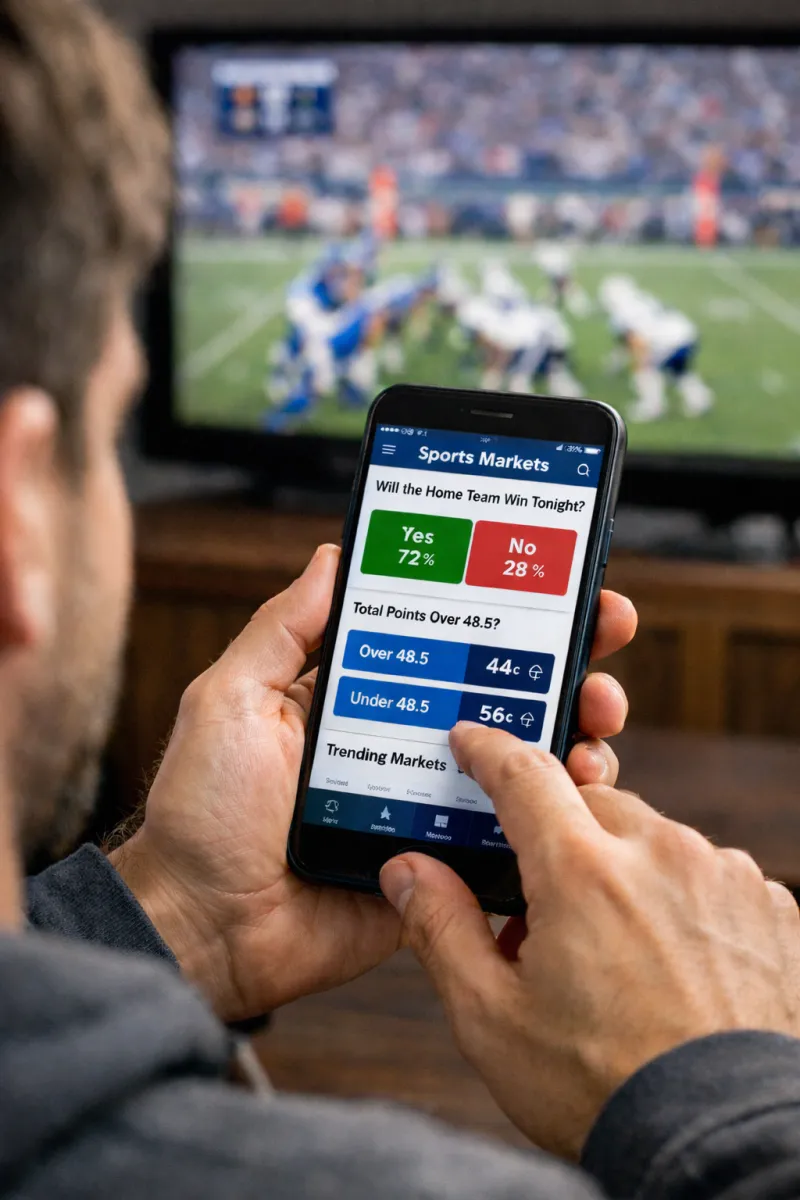
Photo: person calculating odds on smartphone sportsbook app at kitchen table, via www.americangaming.org
If you've spent years setting fantasy lineups or playing daily pick'em, the sportsbook can feel like stepping into a casino back office. Numbers everywhere. Minus signs on both teams. Something called "juice" that sounds like a crime drama subplot.
Here's the secret: you only need to read two things to judge almost any bet. Learn them once, and you'll size up a line faster than most people who've been betting for years.
Number One: Implied Probability (What the Line Is Saying)
Every set of odds is just a probability wearing a costume. Convert it, and the line tells you exactly what the book thinks.
American odds, negative number (the favorite): divide the odds by (odds + 100).
A team at -150? That's 150 ÷ 250 = 60%. The book says this team wins 60% of the time.
American odds, positive number (the underdog): divide 100 by (odds + 100).
An underdog at +200? That's 100 ÷ 300 = roughly 33%. The book gives them about a one-in-three shot.
Run that math in your head a few times and the shortcuts stick: -200 means two-thirds likelihood, +100 is a straight coin flip, +300 is about a quarter, and anything around +400 or longer is a long shot you should expect to lose most of the time.
Why does this matter? Because now every line becomes a question you can actually answer: do I think this team's real chance is better than what the book is charging? If the Chiefs at -150 imply 60% and you believe they're closer to 70%, that's a bet. If you think it's 55%, pass. That's the entire decision, stripped of noise.
Number Two: The Juice (What the Book Is Charging You)
Here's where beginners get picked off. If odds were pure probabilities, both sides of a game would add up to 100%. They never do — because the difference is the book's fee, known as the vig or juice.
Take a standard spread priced at -110 on both sides. Each side implies about 52.4%. Add them up and you get roughly 105%. That extra 5%? That's the house cut, baked into every ticket.
Why should you care? Because juice varies wildly between books, and shopping it is the closest thing to free money in sports betting. A spread at -105 versus -110 saves you about 4.5% per bet. Over a season of betting, that's the difference between a winning and losing year for a lot of people.
A quick gut-check scale for juice:
- -105 to -110: standard, fair pricing
- -115 to -120: getting expensive; the line needs to be really good
- -125 or worse: you're paying a premium — usually only justified on strong reads
On moneylines, watch for books shading favorites deeper than the market (-130 where everyone else posts -120). That shading is juice in a trench coat.
Putting It Together: Three Quick Examples
Moneyline. You see an NBA underdog at +165. Implied probability: 100 ÷ 265 ≈ 38%. If your read — injuries, rest, matchup — says this team wins 4 times in 10, the price is right. If you can't make a case for 38%, the number is irrelevant.
Spread. A -3.5 favorite at -110. Implied: about 52.4%. The juice tells you the book is charging standard rent. Your job isn't to beat the math here — it's to beat the number. Do you genuinely think this team wins by 4+? If yes, fine. If it's a coin flip in your head, the 52.4% tax will grind you down.
Player prop. A batter to record a hit at -140. Implied: 140 ÷ 240 ≈ 58%. Props are where juice hides worst — many books price them at -125 or -140 per side. Before betting, ask whether you can find that prop cheaper elsewhere, or whether the juice alone makes it a pass. Casual bettors lose more on prop pricing than prop picks.
The 30-Second Drill
Next time you open a sportsbook, run this on any bet that catches your eye:
- Convert the odds to a percentage (10 seconds).
- Ask: is my honest estimate higher than that number? (15 seconds.)
- Check the juice — is this the best price available? (5 seconds.)
If you get two yeses out of three, bet it. If not, scroll on. There's always another game.
None of this guarantees wins — nothing does. But it converts betting from vibes into arithmetic, and arithmetic is a game you can actually get better at. Two numbers, thirty seconds, and you're reading lines like the regulars do.